
Art that cannot be perceived does not communicate.
A room full of masterpieces is invisible to someone who cannot see, and incomprehensible to a child or a foreign visitor. Tekeum builds the accessibility layer that makes heritage shared.
Reference framework
Recognised accessibility standards, used as design references.
Each institution is responsible for regulatory compliance in its own context.
WCAG 2.2 · Level AA
Web content accessibility guidelines — used as the design reference for the public web app.
RD 1112/2018
Spanish regulation on web and app accessibility for the public sector.
EAA · EN 301 549
European Accessibility Act and the European standard for ICT product and service accessibility.
For institutions without a budget for professional audio description, and as a support tool for those who already work with accessibility professionals.
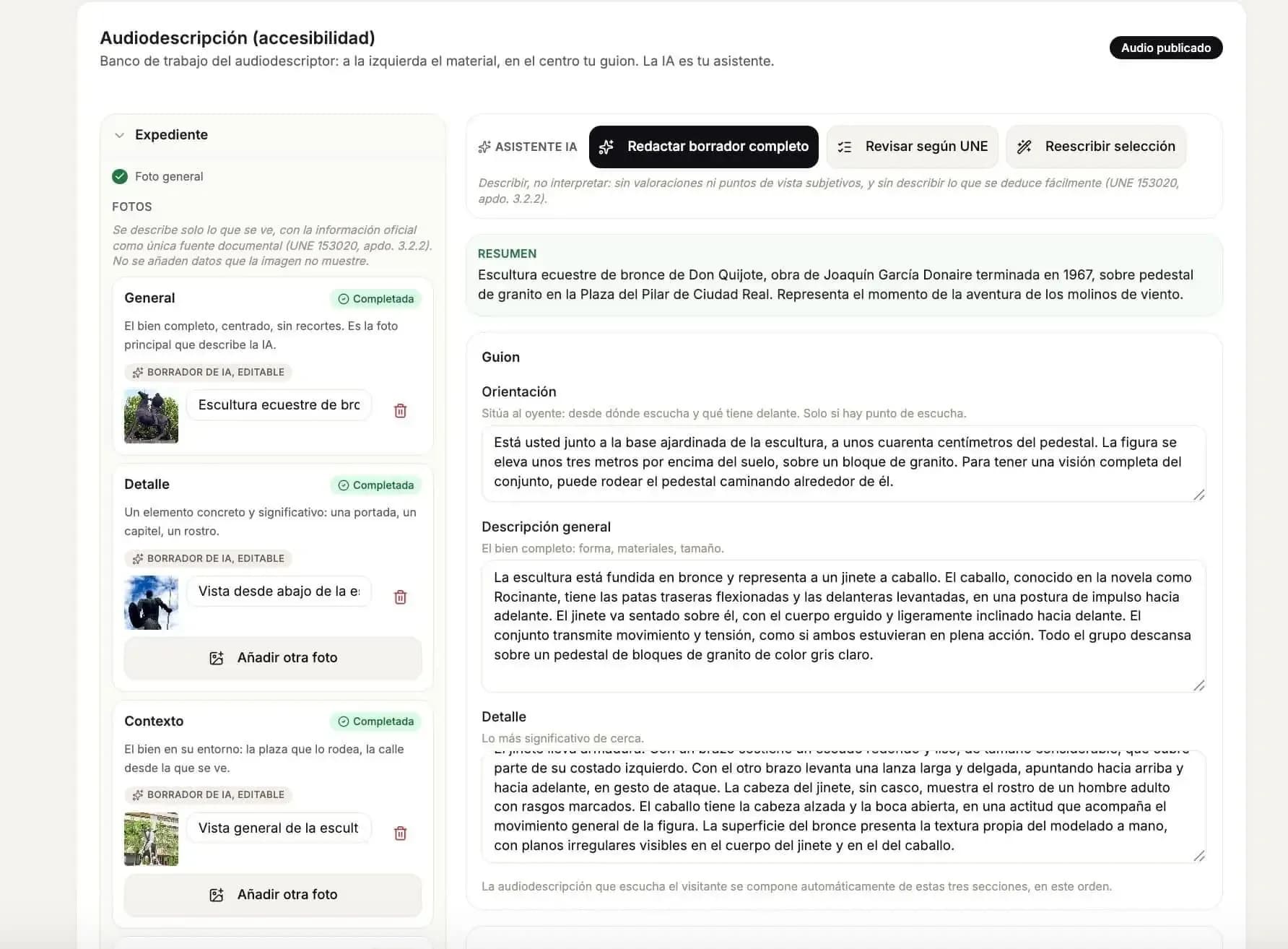
Photo of the artwork or space
Images of the artwork from different angles and levels of detail (overview, listening point, close-up, context).
AI analysis
The system analyses the image and proposes a draft audio description (AD), structured in layers:
- ·Orientation — where the artwork is and how to reach it.
- ·General composition — overall description of the scene or piece.
- ·Detail — specific elements, technique, materials.
Human review and approval
Nothing is published until a person has reviewed and adjusted it and the institution has approved it. The system flags points of uncertainty for the reviewer.
Publication
The audio description is an independent track (voice without music) in its own tab of the same web app, alongside the audio guide and sign language guide.
What the assistant does not do: it does not replace a professional audio describer or publish anything without review.
More layers of accessibility
Sign language guide
Video in Spanish Sign Language (LSE) in the same web app as the audio guide and audio description. The institution's own videos are integrated free of charge; producing new ones is a separate service.
Translation as accessibility
Translation is also linguistic accessibility: a visitor who doesn't speak the local language gets the same content, with the same fidelity.
Alt text on images
Every published artwork image has AI-generated, human-reviewed alternative text for screen readers, in plain language and focused on the essentials.
Kids' audio guide — generational accessibility
Accessibility is also about age: a version for children aged 8 to 12, with challenges and questions, from the same sources and on the same web app.
Accessibility statement
Each institution gets its own accessibility statement, generated automatically from its web app configuration.
Contrast and navigation
The web app automatically corrects colour combinations below minimum legibility and follows keyboard navigation and visible focus criteria.
Tekeum's role alongside accessibility professionals
Tekeum does not replace audio describers, sign language interpreters or accessibility consultants. It reduces the time and cost of a first draft and leaves review and final approval to qualified people.
Tekeum in one minute.
From official sources to a published audio guide.
Frequently asked questions
What accessibility features does Tekeum offer?+
Audio description (AD) for blind and partially sighted visitors, sign guides in Spanish Sign Language (LSE) for deaf visitors, a kids' version and translation into the visitor's language, all in the same web app.
What standards does Tekeum reference?+
WCAG 2.2, Spain's RD 1112/2018 and the European Accessibility Act (EAA), as design references, not as a conformity certification.
Does accessibility require special devices?+
No for audio description and translation, which work on the visitor's own phone. The sign language guide can benefit from a screen for the video.
Try Tekeum for free.
Demo within 24 h
With 3 real pieces from the space, working on a phone.
15-minute review
A video call to go through it with the team.
Quote and preliminary project within 72 h
Tailored to each project.
The demo is uncurated trial content. With the institution's official information, accuracy is fully guaranteed.